Summary
Two biological sciences students, Anish Prasad Lohani and Mohamed Elosta, have published a research paper in the scientific journal, Molecules. The paper, which focuses on using nanotechnology for cancer diagnosis and imaging, began as a class project and was developed with mentorship from Nimer Murshid and Mahmoud Maksoud, highlighting the advanced research opportunities available to undergraduate students at CMU-Q.
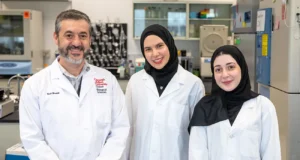
DOHA, QATAR – In a remarkable achievement for undergraduate research, two students at Carnegie Mellon University in Qatar (CMU-Q) have co-authored a scientific paper published in the peer-reviewed journal Molecules. Anish Prasad Lohani and Mohamed Elosta, both biological sciences students, who were rising sophomores when the paper was published, accomplished this feat with the guidance of mentors and co-authors Nimer Murshid, assistant teaching professor of chemistry, and Mahmoud Maksoud, education support specialist in biological sciences.
The paper, titled “Functionalized carbon nanotubes: Emerging nanomaterials for enhanced cancer diagnosis and imaging,” originated as a class project in a new elective course, Nanotechnology in Context. While the assignment ended with the semester, Lohani and Elosta chose to take their project to the next level.
What followed was an intensive mentorship process. Murshid met with the students weekly to expand upon their original paper, adding new sections and deepening the research.
“I involved the students in the process of submission as well, including reviewing and revising,” he explained. “They put in an excellent effort, and not only did they learn about carbon nanotubes, they understand the process that scientists go through to share their work with the research community.
Nanotechnology is a field of science focused on materials that are incredibly small, typically between 1 and 100 nanometers—a nanometer being a billionth of a meter. Because of their tiny size, these nanoparticles have a vastly increased surface area, which gives them unique properties for applications in medicine, electronics for solar cells, and environmental science.
Carnegie Mellon University in Qatar’s Biological Sciences program has a strong laboratory and research focus, which establishes a strong foundation for careers in scientific exploration.