Summary
This story profiles Biological Sciences graduate Khalid Al Abdulla and his multi-year research into aggressive triple-negative breast cancer. Khalid utilized computational methods and Python to identify mechanisms that could reduce cancer aggressiveness, earning him College Honors, a presentation at the International Agency for Research on Cancer conference in France, and first place at CMU-Q’s Meeting of the Minds.
A journey shaped by curiosity
Khalid Al Abdulla’s journey at Carnegie Mellon University in Qatar (CMU-Q) is driven by curiosity, persistence, and a desire to tackle some of science’s most complex challenges. His award-winning work in cancer research reflects both the depth of his academic experience and the potential real-world impact of his findings.
“I’m really proud of this journey. It’s something I’ve been working toward for years,” he said.
Drawn to research
Pursuing a degree in Biological Sciences with a minor in Neuroscience, Khalid chose CMU-Q for its strong research reputation and the promise of hands-on undergraduate research. Like many students, he found the transition challenging at first, but with faculty mentorship and growing personal discipline, his academic journey gained momentum.
“The transition wasn’t easy at first, but with time and support, I was able to turn things around,” he reflected.
From coursework to the lab
Courses in cell biology and cancer biology challenged Khalid to move beyond linear thinking and understand biological systems at a molecular level. A 10-week funded research program then gave him the opportunity to work full-time in a lab, sharpening his technical skills, including applying Python and computational methods to his work. Incrementally, he built the confidence to take on increasingly complex problems.
“That experience pushed me out of my comfort zone and helped me grow both technically and personally,” he said.
Advancing cancer research
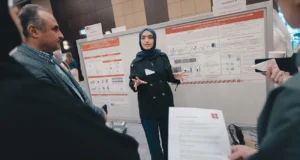
That resilience translated into meaningful, multi-year research. Khalid focused on breast cancer, specifically the aggressive triple-negative subtype, exploring how overexpressed proteins behave within cancer cells and how they might be targeted for treatment. His work identified new mechanisms that may reduce cancer aggressiveness, earning him first place in the Extensive Research Award category at CMU-Q’s Meeting of the Minds.
“We’re exploring how specific changes in cancer cells could open the door to new therapeutic approaches,” he explained.
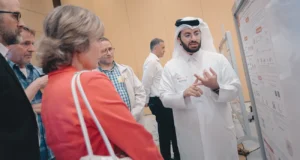
Khalid’s research extended well beyond campus. He presented his work in France at the Cancer Research for Cancer Prevention Conference, co-organized by the International Agency for Research on Cancer, where he was the only undergraduate among PhD-level participants. The experience was a testament to the calibre of research being produced at CMU-Q.
A purpose-driven path
Khalid’s passion for oncology is deeply personal, shaped by the loss of a family member. That experience has given his research a sense of urgency and direction that goes beyond academic achievement.
“That experience shaped my path and pushed me toward cancer research,” he shared.
Looking ahead, he is weighing two paths: medical school focused on oncology, or a research-driven PhD. Ultimately, he hopes to bring both together.
“I want to understand disease at a molecular level and also be able to treat patients,” he said.
Reflecting on his time at CMU-Q, Khalid is clear about what it has meant to him.
“This has been one of the most important parts of my life. I’ll truly miss it,” he said.