Summary
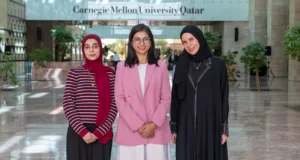
CMU-Q sophomores Iroda Ibrohimova and Madina Mirzatayeva won the Best Oral Presentation award at the International Conference of Machine Vision (ICMV 2025) for their research project on using AI to improve accuracy when counting animals in large groups.
Two Carnegie Mellon University in Qatar (CMU-Q) sophomore students, Iroda Ibrohimova and Madina Mirzatayeva, have received a prestigious Best Oral Presentation Award at the 18th International Conference of Machine Vision (ICMV, 2025) in Paris, France.
The award recognizes their outstanding research project on applying artificial intelligence to solve complex counting problems in nature. The students, both Information Systems majors, were advised by Gianni Di Caro, teaching professor of computer science, throughout the project.
Tackling the challenge of animal counting using deep learning and swarm intelligence
The project was developed over nine intensive weeks during the summer of 2025, following their first year of studies. The students tackled the challenge of accurately counting animals in large aggregations, addressing issues such as occlusion, motion blur, and diverse camera viewpoints using machine learning techniques.
Ibrohimova and Mirzatayeva addressed this challenge by proposing a novel pipeline for generating realistic, automatically annotated datasets. By creating realistic 3D simulations of moving groups of animals, using the principles of swarm intelligence, their approach enables more effective training of deep learning models, ultimately improving counting accuracy in applications such as wildlife monitoring and conservation.
The well-renowned ICMV conference, with proceedings published by SPIE, the International Society for Optics and Photonics, attracts global researchers, graduates, and industry experts. The students’ presentation, delivered in a session focused on computational methods and imaging, was recognized for its excellent content and their smooth, synchronized delivery as a two-person team.
Di Caro, who advised the project, commended the students on their extraordinary effort: “Even as first-year students with limited technical experience, they were highly motivated and truly wanted to do the work. I saw their commitment firsthand—they were here day and night during the summer. That level of engagement is what truly drives impactful research.”