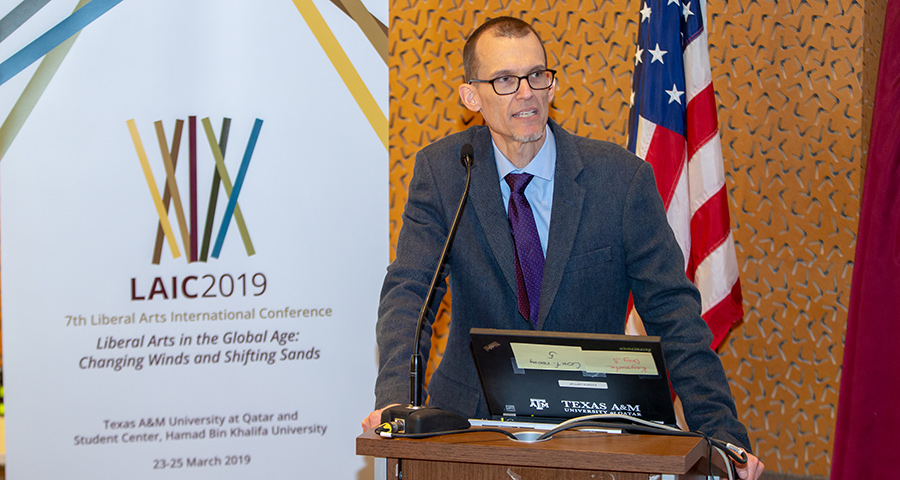
Dudley Reynolds discussed the politics of language learning in Qatar in the closing keynote address at the seventh annual Liberal Arts International Conference. Reynolds was one of several faculty members from Carnegie Mellon University in Qatar (CMU-Q) who presented at the conference.
This year’s conference theme was “Liberal Arts in the global age: Changing winds and shifting sands.” Hosted by Texas A&M University at Qatar, the conference aimed to shed light on the liberal arts in an ever-changing and dynamic global era.
In his address, Reynolds suggested a collaborative approach to language learning that promotes both social integration and global citizenship: “Classrooms are developing approaches to dual language instruction that encourage students to access all their linguistic resources. What if language education in Qatar focused on developing students as competent multilinguals rather than proficient speakers of individual languages?”
Several faculty members also presented their research at the conference. Silvia Pessoa, Thomas Mitchell and Aaron Jacobson discussed an interdisciplinary approach to scaffolding the writing of arguments in history. Taeyong Park’s research examined overfitting in time series analysis with respect to political analysis. Maria Pia Gomez Laich, Divakaran Liginlal and Michael Maune presented their work on teaching analytical argumentative writing across the disciplines.
Carnegie Mellon University follows a distinct approach to undergraduate education that combines professional training with a firm grounding in the arts and sciences. Faculty members in the arts and sciences teach mandatory courses in areas such as chemistry, English, math and physics, as well as elective courses in a wide variety of disciplines, including Arabic studies, design, history, philosophy, and psychology.