Summary
The third annual LifeLines Hackathon, hosted by the Hamad Bin Jassim Center for Computer Science Education at CMU-Q, brought together 284 university and high school students to build innovative tech solutions for health and sustainability challenges in conflict-affected regions.
The Hamad Bin Jassim Center for Computer Science Education at Carnegie Mellon Qatar hosts 71 teams to develop technologies addressing challenges in conflict-affected regions
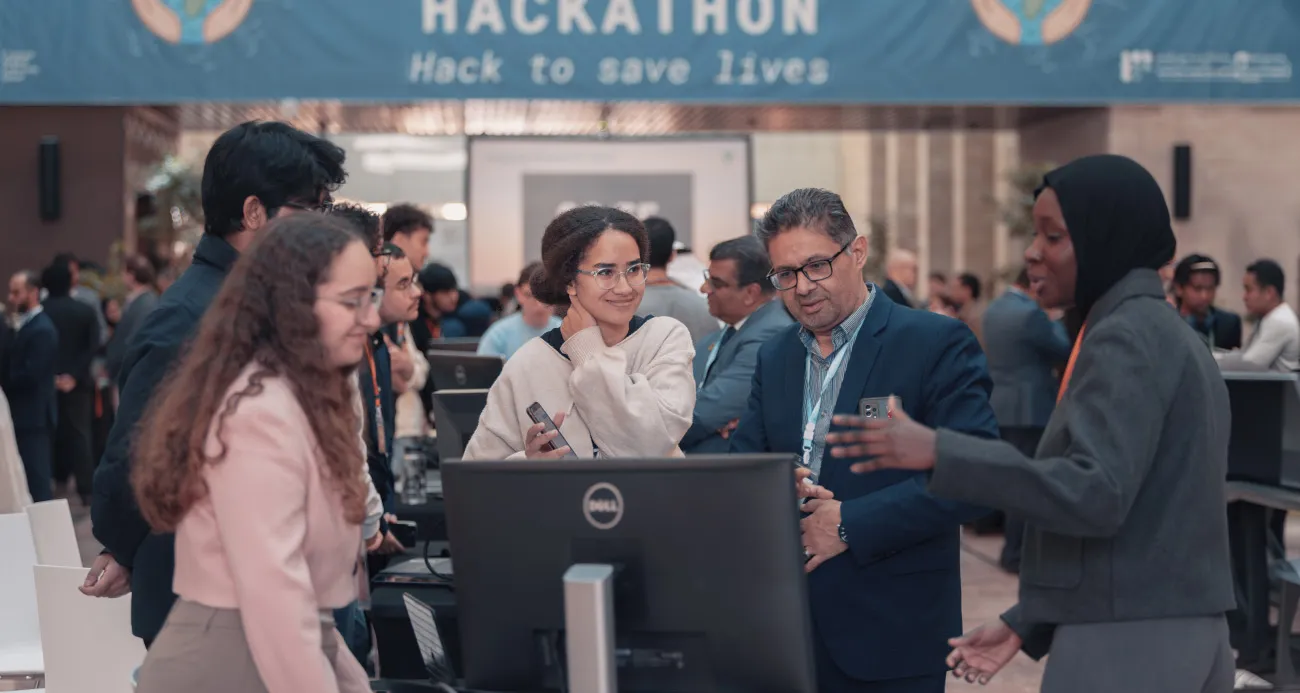
Doha, Qatar – May 4, 2026: The third annual LifeLines Hackathon at Carnegie Mellon University in Qatar (CMU-Q) focused on the theme of offline-first solutions for health and sustainability in crisis zones, drawing a record turnout from students across Qatar. The competitive 10-day event, organized by the Hamad Bin Jassim Center for Computer Science Education, which was established by the Jassim and Hamad Bin Jassim Charitable Foundation in collaboration with CMU-Q, saw 284 students from 19 universities and 31 high schools develop interdisciplinary solutions within this critical area. CMU-Q is a Qatar Foundation partner university.
This year’s focus on health and sustainability themes encouraged participants to explore issues affecting vulnerable populations, with particular emphasis on offline-first approaches that function in environments with limited infrastructure and connectivity.
The HBJ Center is a partnership between CMU-Q and the Jassim and Hamad Bin Jassim Charitable Foundation to encourage students in Qatar to learn the fundamentals of computational thinking and inspire them to shape the future.
Michael Trick, dean of CMU-Q, emphasized the university’s commitment to impactful innovation that addresses real-world humanitarian challenges: “The LifeLines Hackathon exemplifies how we approach challenges at Carnegie Mellon: we seek out thoughtful, human-centered solutions that will work in the real world. I am delighted to see so many young minds come together to imagine a better road ahead for people in conflict zones.”
Dean Trick also noted that the strategic partnership with the Jassim and Hamad Bin Jassim Charitable Foundation is one of the key reasons for the hackathon’s success.
Saeed Mathkar Al-Hajri, CEO and Member of Board Directors from the Jassim and Hamad Bin Jassim Charitable Foundation, said: “We remain dedicated to inspiring young people in Qatar to harness the power of technology to develop meaningful solutions that can improve lives around the world. The LifeLines Hackathon represents exactly the kind of innovative thinking we are proud to support through our partnership with Carnegie Mellon University in Qatar; a partnership that gave rise to the Hamad Bin Jassim Center for Computer Science Education as an ideal platform for learning the fundamentals of computational thinking and computer science.”
The hackathon’s success was also possible through support from Qatar International Islamic Bank (QIIB) and Earthna, the Center for a Sustainable Future in Qatar.
Khalid Abdulrahman al-Shaibei, Chief Business Development Officer at QIIB, noted: “QIIB has a commitment to corporate social responsibility in education, healthcare, and sustainability, themes that align directly with the Lifelines Hackathon. We congratulate all the participants, and especially the winning projects, on their thoughtful, compassionate innovation.”
The winning teams included students from several universities in Doha. The first-place team created a prototype for an offline-first healthcare ecosystem that protects mothers in crisis zones. Team members included Asiyil Alaswad, Waqas Behzad and Ahmed Hanif from the University of Doha for Science and Technology (UDST), and Bakri Mohammed from Texas A&M University at Qatar.
Second place went to an idea for an SMS-based decision support for displaced women to locate safe water, sanitation, and hygiene services. The team included UDST students Ayesha Erum, Saima Nasrin, Arlene Riona, and Anisa Salsabila.
A team from Qatar University secured third place with an offline-first farm recovery platform designed for Gaza. The team included MHD Majd Alesalm, Mohamed Elansari, Abdullah Jamali, and Anas Rustom.
Khaled Harras, senior associate dean for faculty and director of the HBJ Center, said: “The ingenuity demonstrated by the participants this year has been remarkable. The vision of Lifelines is to bring together students, educators, and professionals to develop solutions that combine technology and compassion to offer support and hope to those in need. These ideas have enormous potential to do just that.” Harras is also CMU-Q’s senior associate dean for faculty and a teaching professor of computer science.
The Lifelines Hackathon benefited from an extensive collaborative ecosystem of partners and contributors who provided expertise, mentorship, judging, and workshops. These include Ernst & Young (EY), the German Embassy in Doha, Hamad Bin Khalifa University (HBKU), Hamad Medical Corporation (HMC), Human Capital, Ihsan Venture Studio, Qatar Computing Research Institute (QCRI), Qatar Research, Development, and Innovation Council (QRDI), Qatar University (QU), United Nations Development Programme (UNDP), University of Doha for Science and Technology (UDST), Weill Cornell Medicine–Qatar (WCMQ), and World Innovation Summit for Health (WISH).