We use cookies to ensure that we give you the best experience on our website.
صفحات جديدة باللغة العربية حصريًا قريبًا
يسرّنا الإعلان أننا نعكف حاليًا على إعداد صفحات جديدة مُصمّمة لجمهورنا الناطق باللغة العربية لتقديم تجربة استخدام متميزة ومحتوى مخصص وملائم أكثر لهم.
سنطلق هذه الصفحات المرتقبة قريبًا في الأشهر القليلة
Dedicated Arabic Pages Are Coming Soon
We're excited to announce that we are actively developing new, dedicated pages specifically designed for our Arabic-speaking users. These will offer tailored content and an enhanced experience.
Expected to launch in the next few months. Stay tuned!
Students turn to 3D printing solutions to improve sustainability
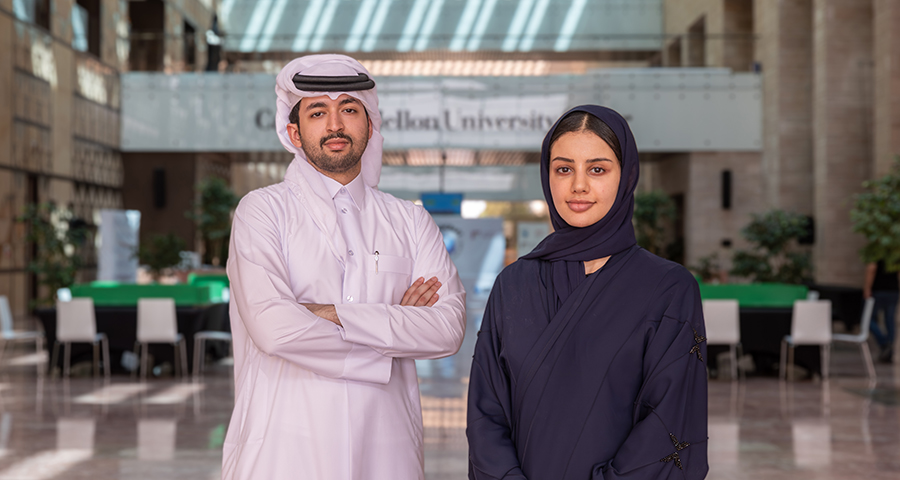
Lujain Al Mansoori and Mohammad Annan, both juniors in information systems at Carnegie Mellon University in Qatar (CMU-Q), are pushing the boundaries of 3D printing to create new solutions to living more sustainably.
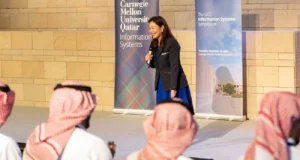
At an information session for the CMU-Q community, Al Mansoori and Annan demonstrated two drastically different ways they are adapting 3D printing technology to create sustainable solutions.
To address food security, Al Mansoori have created i-foods, a solution that would reduce the need for arable land to produce fruits and vegetables: “We are looking into using cell cultures that are created in a lab, and using a specially adapted 3D printer to print out fruits and vegetables.”
A version of the technology is already used for certain meat substitutes. The students felt if they could find a way to create plant foods from cell culture, they could strengthen food security in places like Qatar where agriculture is limited and has a large carbon footprint.
Last summer, the two inventors won the top prize in the food tech category at the Business Incubation and Acceleration Hackathon, hosted by Qatar Development Bank. At that stage, they presented proof-of-concept of their idea by printing a carrot.
This year, they have further developed the idea. Using raspberry cells and a modified extractor, Al Mansoor and Annan have tested printing raspberries.
The technology would allow unlimited creativity when creating fruits and vegetables. This raspberry was printed in Arabic text that spells out Qatar.
“The 3D printing technology opens up many possibilities,” said Annan. “If we can mimic texture and flavor, this idea could be a sustainable option for many places around the world.”
Annan is working on a second start-up idea to use 3D printing technology to create electric motorbikes. “I spent last summer working with Professor Zayed to explore different composites to build the chassis,” said Annan. Along with faculty supervisor Mohamed Zayed, associate teaching professor of physics, he is looking for a novel material that will be both lightweight and safe in a crash.
“Creating a more sustainable world is a passion of mine,” said Annan. “I believe that technology can help us find a way to a brighter and greener future.”