Summary
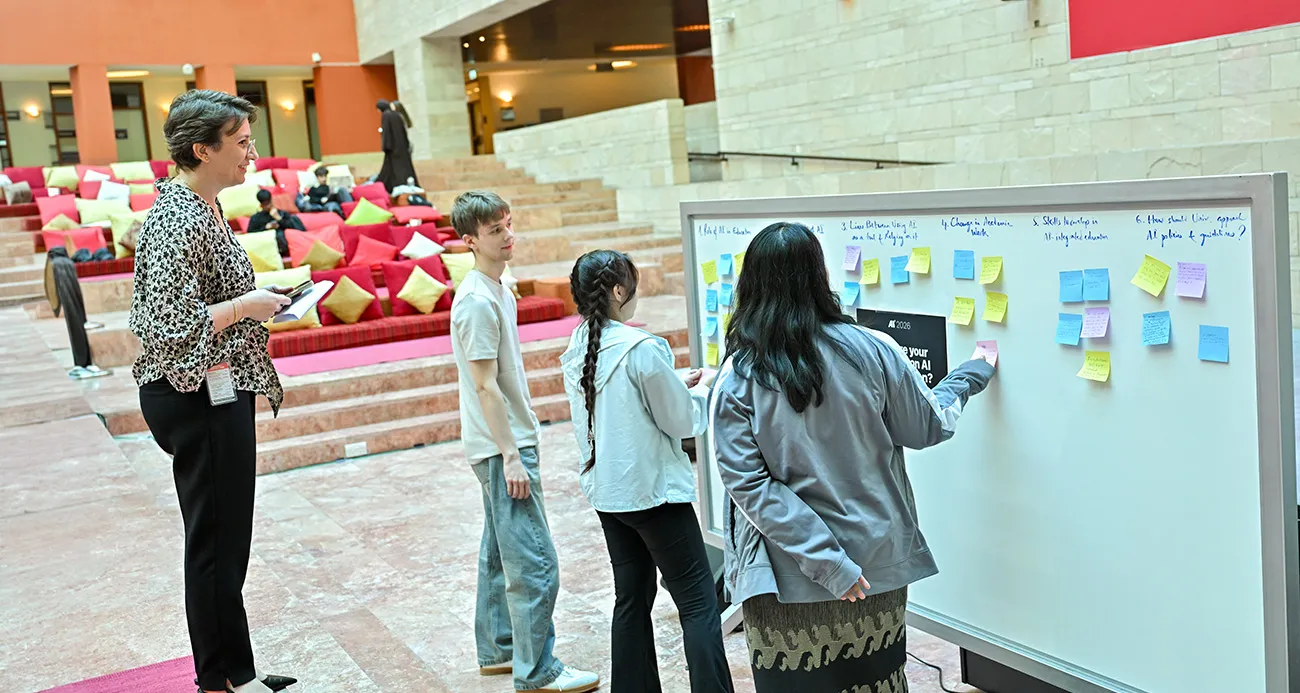
Carnegie Mellon University in Qatar (CMU-Q) recently concluded the second annual edition of AI²@CMU-Q, an award-winning campus-wide program dedicated to AI literacy, ethical awareness, and responsible tech integration. Featuring cross-campus discussions, faculty-student networking, and practical workshops, the initiative was developed at CMU-Q and earned the 2026 ALA Library of the Future Award before expanding to CMU’s main campus in Pittsburgh.
DOHA, QATAR — Carnegie Mellon University in Qatar (CMU-Q) has concluded the second annual AI²@CMU-Q, a campus-wide initiative designed to foster AI literacy, ethical awareness, and responsible technology integration in higher education. The initiative was spearheaded by Reya Saliba, senior librarian, instruction and outreach, and is a cross-campus collaboration that includes the Humanities and Social Sciences faculty members, Student Affairs, CMU-Q Library and Computing Services. CMU-Q is a Qatar Foundation partner university.
Introduced at the beginning of the last academic year, AI²@CMU-Q went on to earn CMU-Q the American Library Association’s prestigious 2026 Library of the Future Award. In Pittsburgh, CMU Libraries has taken the AI²@CMU-Q framework and adapted it for their larger student population and more expansive course offerings. They will host the first AI Fluency Week at the end of October.
At the Qatar campus, the programming this year pairs lectures with interactive breakout sessions to explore the evolving role of generative artificial intelligence in academic life. The week opened with a session led by Andrew Bassford, assistant teaching professor of philosophy. The discussion challenged faculty and students to examine the philosophical concepts of thinking, academic integrity, and extending the mind with tools like notebooks, smartphones, and AI systems.
To bridge the gap between classroom expectations and student practice, Magnus Liebherr, visiting assistant professor of psychology, and student Amr Aloure led a student-faculty networking session to discuss the assumptions, terminology, and shared expectations of using AI tools for learning.
The series concluded with a practical workshop led by Mohammed Al-Sadi, AI engineer, that outlined campus-vetted AI resources and clear guidelines on using them responsibly and with integrity.