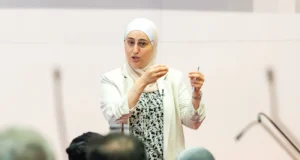
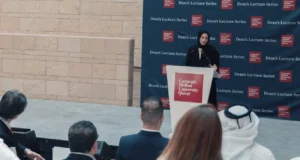
DOHA, QATAR – Alex Waibel, Ph.D., professor of Computer Science at the Language Technology Institute at Carnegie Mellon and the Institute of Anthropomatics at the University of Karlsruhe, gave a lecture Monday night that discussed technology solutions to communication challenges we face today, as societies do not yet share a common global language platform.
“As an increasingly global society continues to bring us together, it is no longer the ‘digital divide’ that separates us, rather the ‘language divide,’” said Waibel. “Forcing uniformity in language is neither realistic nor desirable with the beauty and individuality of each language and culture. There are technology solutions available which maintain cultural diversity while enabling the integration, communication and collaboration of the modern world.”
Over the years, mobile and communication technologies have made it possible to get more and more people connected across the globe. However, speech-to-speech technologies enabling effective interpersonal communication among people who do not share the same common spoken language are still being developed. The goal of such translation technologies is to overcome critical language barriers in the real world to enable effective collaboration and understanding.
Waibel directs the International Center for Advanced Communication Technologies (InterACT) with research interests in multimodal and multilingual human communication systems. He is one of the founders and chairmen of C-STAR, the consortium for speech translation research.
Waibel presented some of these speech communication technologies – including a computer dialog translator for laptops, a road sign translator, a system that translates academic lectures in real-time and the world’s first commercially available speech translator that runs on a telephone. He reviewed how these technologies work, what levels of performance are currently possible and how to deliver the technology so that language separation will no longer hinder communication. There were live demonstrations which accompanied the lecture, including an application for iPhone where an English language dialogue was simultaneously translated into Spanish.
“Using technology to interpret the language is fundamental to bridging the language divide,” said Waibel during the lecture. “We are developing tools to make language differences transparent in order to help human beings communicate better with each other.”
“We are pleased to have such an expert in the field of language translation technology here to present these advancements to our Qatar Foundation and Education City communities,” said Kemal Oflazer, Ph.D., computer science professor at Carnegie Mellon Qatar. “At Carnegie Mellon Qatar we are currently working on some language translation projects in collaboration with our colleagues in Pittsburgh regarding speech and other issues related to the Arabic language. We see practical applications in the classroom where real-time lecture translation will help students overcome language issues. This state-of-the-art technology will also have relevance to larger scale projects within Education City.”
ABOUT CARNEGIE MELLON
With more than a century of academic excellence and innovative research, Carnegie Mellon University is a global leader in education with real-world applications. Consistently top ranked, Carnegie Mellon offers a distinct mix of programs to its 11,000 students at campuses around the globe. Core values of innovation, creativity, problem solving and collaborative teamwork provide the foundation for everything we do.
At the invitation of Qatar Foundation, Carnegie Mellon joined Education City in 2004. Here, Qatar Foundation has created a world-class center for scholarship and research that is the ideal complement to Carnegie Mellon’s tradition of innovation through collaboration. Carnegie Mellon University in Qatar offers its highly regarded undergraduate programs in business administration, computer science and information systems to students in Qatar and the Gulf Region.