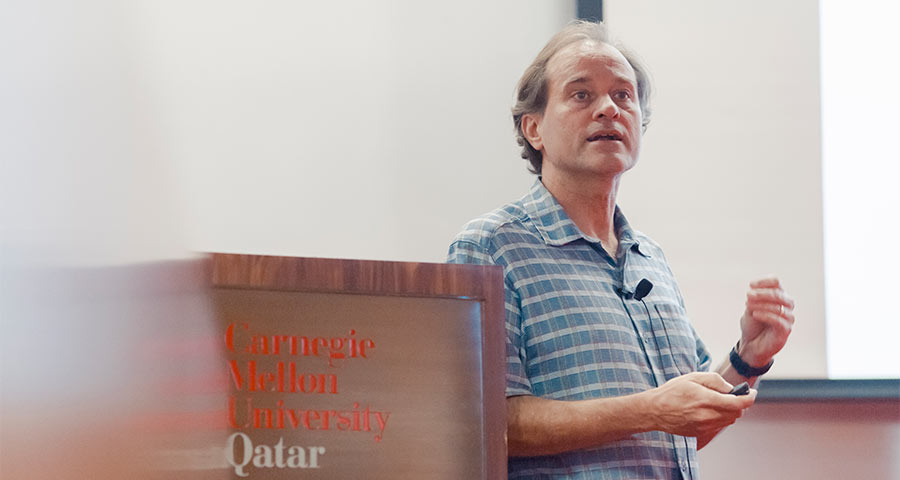
Guy Blelloch, the associate dean for undergraduate education at Carnegie Mellon’s School of Computer Science, outlined the rising importance of parallel algorithms in today’s computing at a Dean’s Lecture yesterday.
Blelloch, who joined the faculty of Carnegie Mellon in 1988, charted the history of parallel algorithms. “Almost all computers and devices are now parallel. Even the simplest devices have parallel processors,” said Blelloch.
Parallel processors allow devices to compute more efficiently and save significantly on power usage. Blelloch feels, however, that education in parallel algorithms must keep up with technological advances in the industry.
Blelloch is one of the world’s pre-eminent researchers in the area of parallel computation. He worked on one of the early parallel machines, the Thinking Machines Connection Machine, where he developed several of the parallel primitives. At Carnegie Mellon, Blelloch designed and implemented the programming language NESL, a language designed for easily expressing parallel algorithms. Other work on parallelism has addressed issues in scheduling, algorithm design, cache efficiency, garbage collection, and synchronization primitives.