We use cookies to ensure that we give you the best experience on our website.
صفحات جديدة باللغة العربية حصريًا قريبًا
يسرّنا الإعلان أننا نعكف حاليًا على إعداد صفحات جديدة مُصمّمة لجمهورنا الناطق باللغة العربية لتقديم تجربة استخدام متميزة ومحتوى مخصص وملائم أكثر لهم.
سنطلق هذه الصفحات المرتقبة قريبًا في الأشهر القليلة
Dedicated Arabic Pages Are Coming Soon
We're excited to announce that we are actively developing new, dedicated pages specifically designed for our Arabic-speaking users. These will offer tailored content and an enhanced experience.
Expected to launch in the next few months. Stay tuned!
Sample text 123
Information Systems
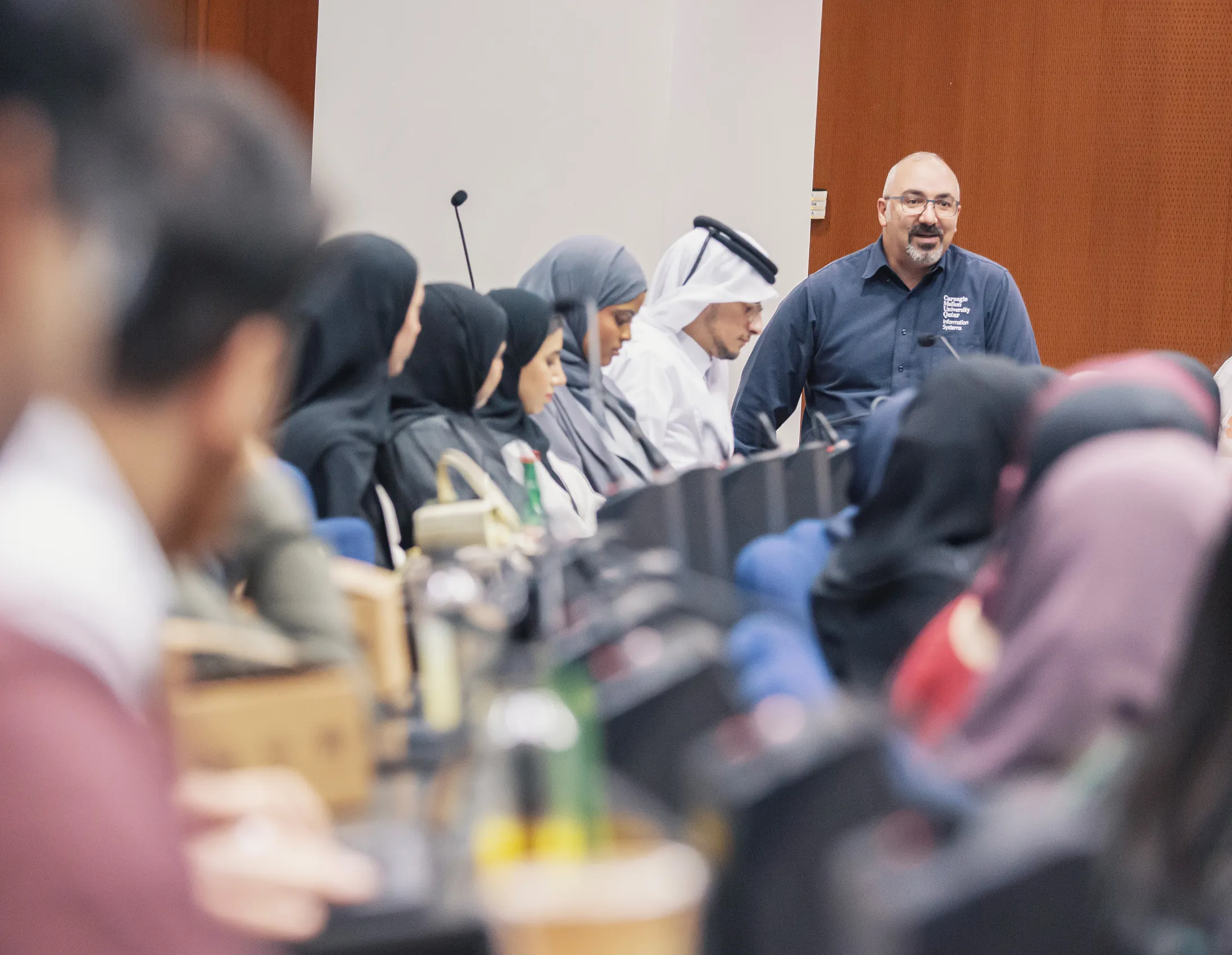
Information Systems students develop expertise in designing and implementing human-centered, technology-driven solutions that drive transformative impact across organizations, public services, and society.
Information Systems at Carnegie Mellon
Top-ranked globally, CMU’s Information Systems program combines aspects of computer science, information technology, and business management with a humanities and social sciences-based education. Students are positioned for an impactful career in a digitized and connected world, and they are prepared to adapt and thrive as technology evolves.
The Information Systems program at CMU is:
Strongly technical, drawing from CMU’s leadership in computer science, human-centered design, and software engineering
Rooted in a rich tradition of the humanities and social sciences
Built on a foundation of data analytics and experiential learning
Flexible and adaptable, encouraging students to forge their own path in emerging fields
Information Systems students have identical graduation requirements as students at Carnegie Mellon in Pittsburgh. Graduates have CMU degrees, conferred from the U.S. campus.
Program at a Glance
The program blends technical foundations in computing and software development with social sciences and organizational theory, preparing students to think critically about how technology shapes, and is shaped by, people, organizations, and society.
The curriculum includes:
Information systems core
Technical core
Information systems breadth
Information systems concentrations
University core courses in general education
Through hands-on courses and team-based projects, students gain practical experience by collaborating with real-world clients to design and deliver technology-driven solutions such as mobile apps, data dashboards, workflow systems, digital platforms, and artificial intelligence integrations.
The multidisciplinary nature of the program encourages students to explore their interests. Students select an approved minor, or a concentration area in one of these IS fields:
Information security and privacy
Data science
Emerging technology management
Degree Program Details
Curriculum
The Bachelor of Science degree in Information Systems is based on professional core courses that teach students to analyze, design, implement and test information systems using current and emerging organizational and technological practices. Several of these courses are project-based, in which small groups develop solutions to real information problems.
The program exposes students to the areas fundamental to understanding problems in information systems: organizations, decision making, research methods and professional communications. Courses in mathematics, statistics and computer programming provide students with strong quantitative skills to meet the technical demands of the discipline.
The cross-disciplinary nature of the program encourages students to explore their interests. Students may specialize in information security and privacy, data science, or emerging technology management.
Dietrich College Senior Honors Program
The Dietrich College Senior Honors Program is a prestigious, two-semester capstone project. Working closely with their advisor, students conduct an in-depth research study or creative project, culminating in presentations at College Honors and the CMU-Q Meeting of the Minds undergraduate research symposium. Students often develop their work to present it at an international conference, or publish it in a peer-reviewed journal.
Program breakdown
Standard completion time: 4 years
Minimum units required for degree: 360 units
Information Systems core: 77
Technical core (Mathematics and Computer Science): 42
Information Systems breadth (Professional Communications, Quantitative Analysis and Research Methods, Innovation and Entrepreneurship): 30
Concentration area or approved minor, and electives: 211
Concentrations provide students with the opportunity to develop a deeper understanding in an IS field of their interest.
Information Security and Privacy
The Information Security and Privacy concentration exposes students to the key technical, process, and policy aspects related to information security and associated privacy concerns. It equips students with practical skills to identify, assess, and mitigate emerging security and privacy threats in real-world environments. Students who complete this concentration have a solid foundation in the area and will be prepared to continue developing expertise through graduate school or their professional career.
Data Science
The Data Science concentration prepares students to capitalize on the continuously expanding quantity of data generated through our interconnected information systems. Students develop an understanding of how to store, process, retrieve, and analyze data so they can derive insights and improve decision making for individuals, organizations, and society. The foundation developed in this concentration prepares graduates to assist organizations to harness the data they generate, as well as to support research projects either as a graduate student or within a chosen profession
Emerging Technology Management
The Emerging Technology Management concentration prepares students to lead in a world transformed by AI, digitalization, and emerging technologies. Combining technical fluency with strategic and managerial skills, this concentration equips students to drive innovation, lead digital transformation, and address real-world challenges. Through hands-on experiences and applied projects, students gain the practical insight needed to deliver tangible impacts across industries and society.
Hands-on Learning
Projects courses
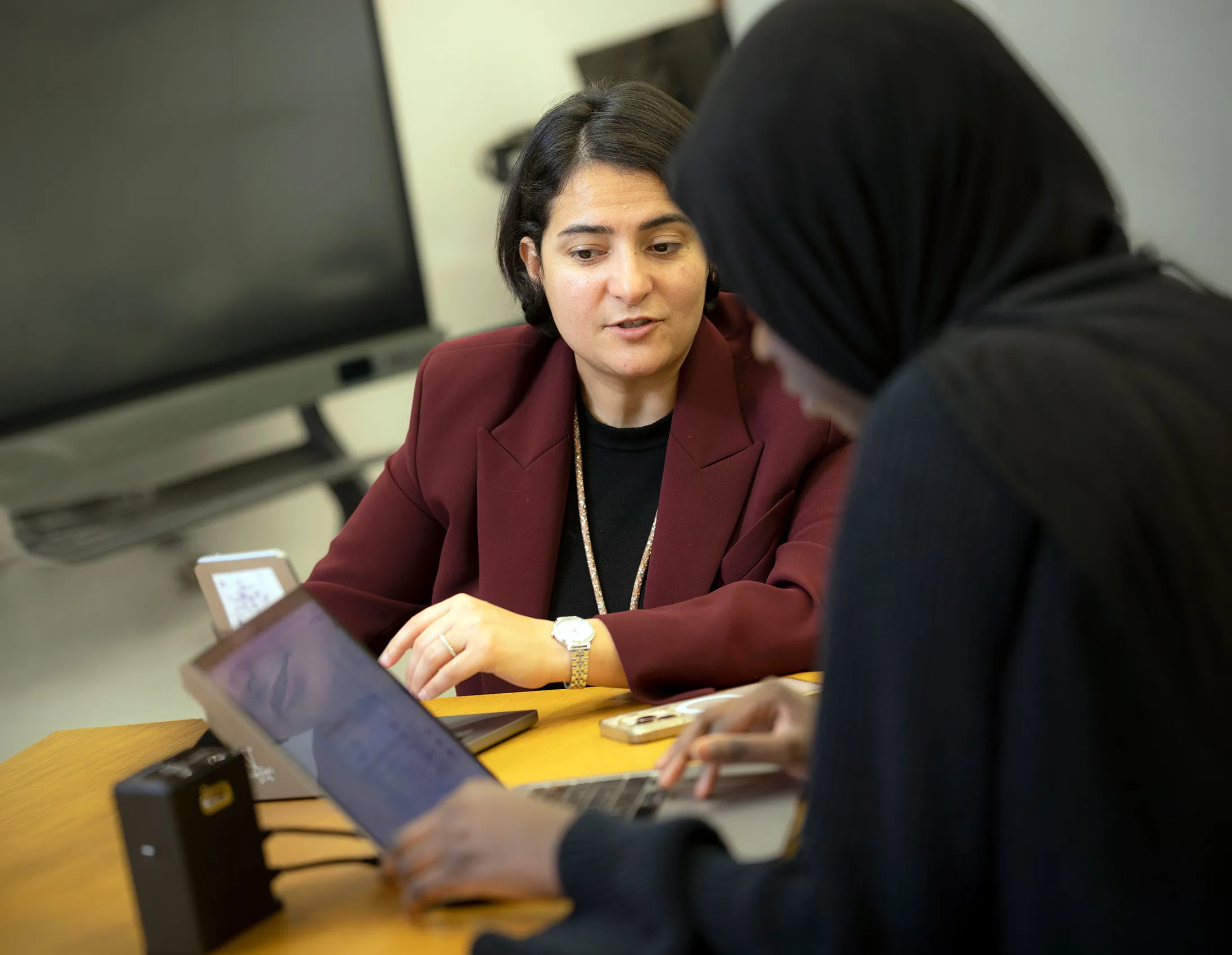
Teamwork is a foundation of our Information Systems program. Information Systems students put theory into practice through semester-length, team-based project courses.
In these courses, students gain valuable experience managing complex projects, working closely with teammates and dealing with the ambiguities inherent in every large-scale industry-focused project.
iX Lab for Emerging Technologies
The iX Lab is a hub for research, education, and industry collaboration on emerging technologies.
The lab features dedicated stations focused on real-world applications, including AI personas, conversational AI, IoT and motion detection, immersive technologies, applied AI and robotics, digital forensics, and sustainability and green tech.
It provides students with hands-on research and development experiences, offering practical perspectives that are closely aligned with industry needs and the Information Systems curriculum.
Student Projects and Research
Research at Carnegie Mellon
At Carnegie Mellon, our mission is to investigate questions that will have a real impact on the world.
As our undergraduates engage in research, we encourage them to think about the question, “why does this research matter?” This is a hallmark of Carnegie Mellon’s approach.
Students in every major can engage in faculty-guided projects in their early years and pursue independent studies and senior thesis projects as they gain knowledge and experience.
What kind of research projects do CMU-Q students do?
Dyslexia-aware modeling of reading difficulty in Arabic
A study on the key drivers of AI capability and startup performance in Qatar
Aging population and bridging the digital divide
Modeling freight cost for critical commodities in conflict zones: A case study on Ukrainian wheat
Secure and privacy-preserving emotion detection: Integrating AI, blockchain, and privacy-enhancing technologies in AI assistants
Exploring the role of generative artificial intelligence in enhancing programmers’ learning effectiveness
Exploring gender bias in STEM fields – implications for female representation in academia
Modeling factors affecting the adoption of location-based gaming for community building
Telehealth during and post-pandemic: The case of Qatar
Factors influencing sensitivities of online privacy: The case of e-learning in Qatar
How effective are web accessibility regulations
Factors affecting the adoption of virtual reality for fitness in Qatar
Exploring perceptions of social movements in social media during Covid-19
Automatic Arabic translation of English educational content online using neural machine translation: The case of Khan Academy
Exploring resilience in the digital age: A behavioral perspective with Qatar as a case study
Design for a change: Examining the effect of micro-interactions on student reading engagement
Examining the relationships and patterns in patient-initiated vlogs and their impact on patient’s wellbeing
Using drones to enhance the independence of the elderly population in Qatar: A technology acceptance study
RISE: Realtime information systems for emergency detection
Typical career fields for new information systems graduates include project managers, IT and risk management consultants, entrepreneurial ventures, business analysts, web and mobile application developers, application designers and user experience testing.
Qatar
Civil Service and Government Development Bureau
Director of Planning and Monitoring of Government
Services Performances
Cosette Solutions
Co-Founder and CEO
DeloitteManager
Education Above All Foundation
Head of Policy and Research
Flare Business
Partner, Chief Strategy Officer
Galeries Lafayette, Ali Bin Ali
Merchandise Planner
Malomatia
Director, Business Solutions
Microsoft
Cloud and AI Lead, Public Sector
Ministry of Communications and Information Technology
Director of Digital Innovation
Ministry of Defense
Head of Research and Development Morale Guidance
Ooredoo Qatar
Senior UX Designer
PwC
Emerging Tech Innovation Lead and Qatar Lab Lead
Qatar Airways
Crew Optimization Specialist
Qatar Foundation
Manager, Social Media
Qatar Investment Authority
Chief of Staff
Senior Analyst, Portfolio Risk and Analytics
Qatar National Bank
Cybersecurity Director
QatarEnergy
Senior Business Analyst
QatarEnergy
Lead of Drilling and Production Solutions
Senior Security Data Scientist
Schlumberger
Data Scientist
Sidra Medicine
ERP Specialist
Snoonu
Group Product Manager
State Audit Bureau
Head of Data Center
International
Cambridge
GSK
Associate Director of Computational Biology
Dubai
Bond Brand Consultancy
Design Strategist
Manama
American University of Bahrain
Assistant Professor of Computer Science
New York
Apple Bank
Manager, Data Analytics
GE Aerospace
Executive, Artificial Intelligence
Pittsburgh
InfraShield
Customer Solutions Engineer
Seattle
Microsoft
Principal Product Manager, Copilot AI for
Microsoft Teams Meetings
Singapore
GovTech Singapore
Senior Software Engineer
Sydney
Qoria
Senior Product Designer
The Royal Australasian College of Physicians
Digital Learning Lead
Toronto
CIBC
User Experience Researcher
LaunchGood
Senior Product Designer
Further studies
Information Systems graduates have furthered their studies
at elite institutions, including:
Boston University
Carnegie Mellon University
Cornell Tech Campus
Georgetown University
Hamad Bin Khalifa University
Harvard University
HEC Paris
Parsons School of Design
Trinity College Dublin
University of California Los Angeles
University of Cambridge
University of Oxford
University of Pittsburgh
University of Toronto
Victoria University
“At Carnegie Mellon, the education is delivered in the same way to everyone, but where the beauty lies is that even if 10 students do the same classes, they can pursue vastly different career paths. This is what leads to transformation, disruption, and innovation that can change the world.”
Farjana Salahuddin, Information Systems 2017, Chief Operating Officer, STA, Interactive media artist
“Being part of CMU-Q was a defining moment in my life. As a student, I was constantly encouraged to seek knowledge from various disciplines beyond my own. The skills I gained at university helped me become more innovative and technology-focused.”
Maryam Al-Naemi, Information Systems 2018, Lead of Industrial Solutions, QatarEnergy
“The CMU-Q student experience is unique. Throughout your time as a student, you are encouraged to take what you learn and apply it into real life projects.”
Mohammed Al-Qassabi, Information Systems 2022, Senior Security Data Scientist, QatarEnergy
“The CMU-Q approach starts with: what can I do to make the world a better place? Education is the first step. We learned marketing, we learned sales, we developed the skills to recruit a team of experts, to agree on a single vision, and to achieve that vision. All of these things are important in shaping a better future.”
Abdulla Al-Khenji, Information Systems 2015, Co-Founder and Chief Strategy Officer, Flare Business
Meet the Faculty
Faculty members include experts in AI, AI regulation, innovation diffusion, green information systems, natural language processing and computational linguistics, digital entrepreneurship, social commerce, human-computer interaction, information security and digital forensics, health informatics, data-driven decision-making, and hybrid intelligence.