Summary
As Qatar Sustainability Week comes to a close, CMU-Q faculty member Duygu Sever challenges conventional checklists and defines sustainability as an interconnected system balancing environment, society, and economy. Highlighting the objectives of the Qatar National Vision 2030 and the Third National Development Strategy, she emphasizes that meaningful sustainability requires systems thinking, local stakeholder ownership, and collective long-term agency.
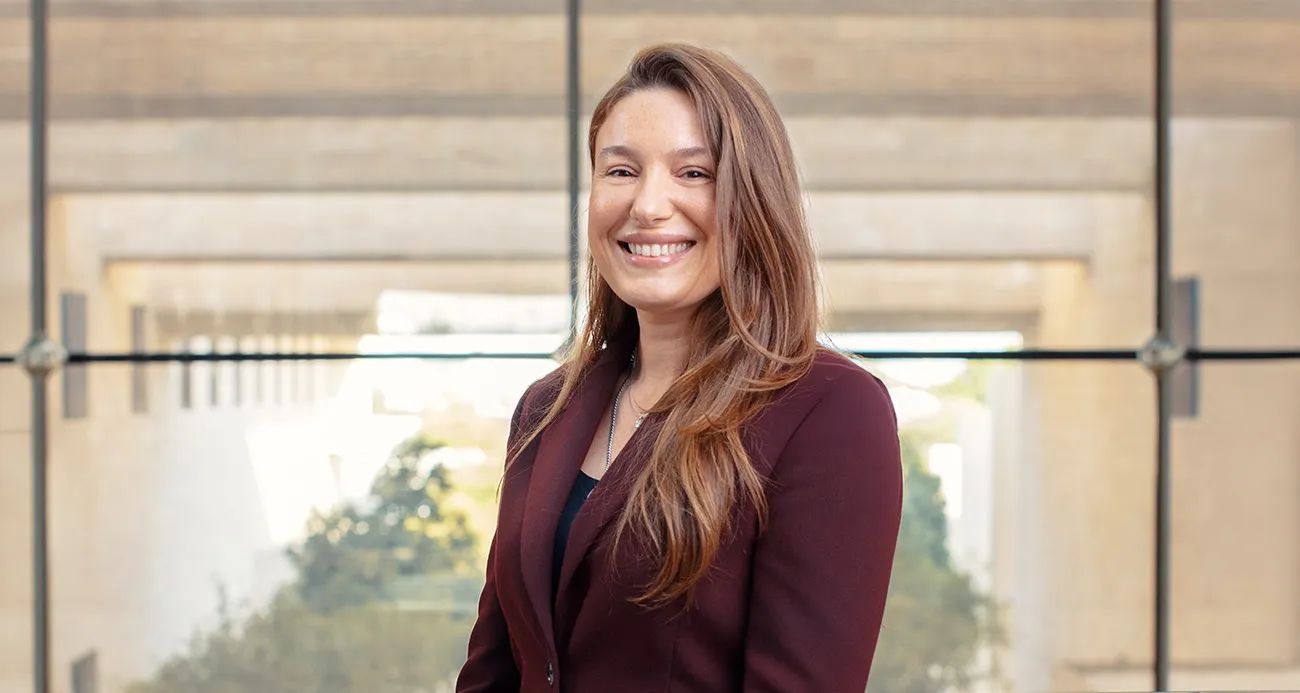
Dr. S. Duygu Sever is a visiting assistant professor at CMU-Q and an expert in energy transition, climate change, nuclear energy, and sustainable development.
Qatar Sustainability Week gives us an opportunity to pause and reflect on a fundamental question: what do we really mean by sustainability?
Famously defined as “development that meets the needs of the present without compromising the ability of future generations to meet their own needs”, sustainable development, in its core, requires a shift away from a human-centered approach towards recognizing the intrinsic value of ecosystems, with humans as part of the whole rather than masters of it. While this definition signals an immediate connection to the environment, in fact sustainability requires simultaneous and balanced progress across three dimensions: environment, society and economy.
For Qatar, this perspective aligns closely with Qatar National Vision 2030 built around four interconnected pillars of human, social, economic and environmental development, and with the Third Qatar National Development Strategy 2024–2030 which places a sustainable future at the heart of the country’s development. Protecting natural systems and resources, promoting social wellbeing and inclusion, and supporting economic prosperity, accountability and governance all together build blocks of resilience, and none can be secured in isolation.
This brings us to one of the most important principles: sustainability is not a topic or a separate environmental agenda, but a way of thinking about and seeing the world around us. It is a system of relationships shaped by both synergies and trade-offs. The contribution of any decision depends on how its consequences interact, who benefits, who bears the costs and what options remain open to future generations. Sustainability therefore cannot be reduced to a checklist, as it rather offers a lens for systems-thinking that helps us see how our choices shape interconnected systems, recognize how their consequences extend beyond the immediate moment, and make decisions that protect the possibility of a good future.
Translating this way of thinking into meaningful action begins with localization. Sustainable development cannot simply be based on global goals and discourses as ready-made models. It must be shaped in context, drawing on local ecological conditions, knowledge, values and social fabric. Local stakeholders are not merely audiences for sustainability initiatives, they are contributors to their design, ownership and long-term success.
Qatar Sustainability Week provides a platform for moving the conversation beyond awareness and towards deeper practice by connecting initiatives, amplifying local voices and building relationships. Showcasing local efforts does more than celebrate individual achievements. It makes solutions visible, encourages learning and allows promising ideas to reinforce one another. When these connections develop into partnerships and collective action, their impact extends well beyond the event itself.
Ultimately, the question is not simply whether an initiative is “green”, but whether it contributes to a system operating within ecological limits and whether its benefits and burdens are fairly understood. Sustainability is both a shared responsibility and a question of agency. Across our different roles as policymakers, researchers, business leaders, educators or citizens, our choices influence the wider system. The challenge is to recognize where our contribution can matter most and to make conscious choices about the kind of future we want to build. After all, the decisions we make today will shape the world we inherit tomorrow.