To most people, the word “banquet” conjures up images of a feast fit for a king. So it seems a little ironic to have a feast to discuss hunger.
But this fall, Carnegie Mellon Qatar’s Office of Personal Development & Counseling Services, in collaboration with Texas A&M University at Qatar’s Department of Student Affairs, hosted an unusual kind of banquet to address local and global hunger.
At the Hunger Banquet, only six out of 50 attendees – representing the 15 percent of the world who are considered high income – were given a king’s meal, while the majority of participants received a much more modest supper.
Faculty, staff and students were invited to participate in the dinner. As each guest entered, they randomly drew a card that decided which income group they belonged to, where they sat, and what kind of meal they received. The low-income group sat on carpets on the floor and dined on rice and water; the middle-income group helped themselves to a slightly more nutritious meal of rice and gravy at simple wooden tables; and the high-income group was served a three-course meal at a lavishly decorated table. Since nobody expected this, the surprise element was what ultimately succeeded in delivering the evening’s message: to encourage people to actively participate in addressing hunger.
According to Dalia Rehal, student development coordinator, the Hunger Banquet concept was first used by the charity Oxfam to highlight how a lack of public policy, education and access to resources can all contribute to hunger.
With the help of eight student facilitators, participants from the two universities sat together in their income groups, talked about hunger and provided different perspectives on how to tackle it. Among the figures highlighted were that a child dies from hunger-related causes every 8 to 12 seconds and that one-in-seven people in the world go to bed hungry each night. During the discussion, members of the high-income group hesitantly picked at their food, asking permission to share with the others, while the low-income group openly complained about their dissatisfied appetites.
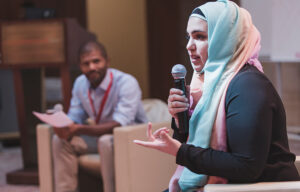
“The way the Hunger Banquet was conducted – instead of just sitting around and discussing – felt much more real”, said Muna Al-Husseiny, a freshman in business administration and a member of the vastly outnumbered high-income group.
Despite knowing already that some people are less fortunate than others, the attendees agreed that this was a wake-up call, with many students deciding to create service projects and clubs to address the issue. “I definitely plan on actively helping with this issue when I go back home,” Al-Husseiny said.
Although the Hunger Banquet proved an interactive way of spreading awareness about hunger, Rehal said she doesn’t plan to make it an annual event. “The event is made more significant by the fact that the guests did not know what to expect. Once the element of surprise is gone, it is difficult to deliver the message as strongly,” Rehal said, adding, “However, I would like an annual way to address hunger issues and encourage those who came to the Hunger Banquet to initiate such events.”