DOHA, QATAR – Hazawi, the word used in the Arabian Gulf dialect stories, is a volume of essays and illustrated poems that features pieces by Education City students, alumni, and educators from various institutions across Qatar. The bilingual book is the latest contribution to the increasing efforts to document and witness the experiences of people who live, work and study in Doha at this great time of change which began in 2008 with the first volume of the Qatar Narratives series. As Qatar is a country with growing body of documentation of its history, this book provides an opportunity for students, and educators, residents, and citizens to reflect and share their perspectives with a wider audience.
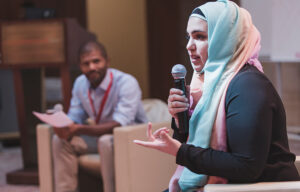
Carnegie Mellon University in Qatar hosted the book launch for Hazawi Sunday, April 18. The book was a collaboration between Silvia Pessoa, Ph.D., of Carnegie Mellon Qatar; Mohana Rajakumar, Ph.D., of Bloomsbury Qatar Foundation Publishing; and Halim Choueriry, formerly of Virginia Commonwealth Qatar.
“We are all very interested in involving people in writing to document their voices and document Qatar’s history and development. There is so much going on in this country but there is very little documentation of it. We wanted to get the participants in all of this change together to share their voices.” says Pessoa, a professor at Carnegie Mellon Qatar.
As the fourth title in the Qatar Narratives series, Hazawi contributes to a growing body of work by the residents and citizens of Qatar. The first three books in the Qatar Narrative series feature essays and photography by residents and citizens living in Qatar from a variety of professional backgrounds and interests. Series creator, Rajakumar began the series as part of an interest in promoting a community of writers and readers. This title builds on that theme by adding voices of migrant workers. “These people have contributed so much to the development of this country but are in the margins of society. We wanted to bring their voices out,” says Pessoa.
Hazawi consists of three sections that aim to portray the social dynamics in Qatar, particularly in the educational context: Stories from the Center, Stories from the Margins and Stories from In Between. Students are at the center of a student-centered educational environment and at the same time at the center of the continuous modernization and changes going on in Qatar, with many, receiving great benefits, and thus, being literally in the center. These students narrate stories of Qatar’s past, present, and future, with the aim of preserving Qatar’s history and identity while embracing Qatar’s development and progress in both words and also using graphic design elements
Alternatively a group of students in this project interviewed the laborers in Qatar, thereby entering into the margins of the social framework. The book also includes perspectives from those who work with students directly: faculty at the various institutions in Qatar. In a physical sense this space can be described as in between those who are in the center – the students – and those who serve them – the laborers.
Stories from the Margins: This section includes essays written by students at Carnegie Mellon Qatar foregrounding interviews with guest workers in Qatar. Edited by Silvia Pessoa, Ph.D., these essays were selected from projects written by students in a course entitled Linguistic and Social Aspects of Immigration, which Pessoa teaches. Stories from In Between: This section features essays written by educators in Qatar who talk about their experience working with students in the Qatari context. Edited by Mohanalakshmi Rajakumar, Ph.D., the creative non-fiction pieces in this section feature social commentary about aspects or incidents of working with undergraduate students. Altogether the essays reflect on what it means to be an expatriate educator/academic/researcher in Qatar. Stories from the Center: This section features essays conveyed via a mixture of text and graphic art of Qatar’s past and present by students at Virginia Commonwealth University in Qatar. These stories were selected from a series of two previous publications, entitled Rituals and Hazawi, which is what gave our series its name.
Hazawi – the fourth volume of Qatar Narratives – is a grant project and available free copies acan be obtained by contacting Silvia Pessoa at Carnegie Mellon University in Qatar. Qatar Narratives, Qatar: Then and Now, and Dreesha, volumes 1-3 in the series, can be purchased at Virgin Megastores.
ABOUT CARNEGIE MELLON
With more than a century of academic excellence and distinguished research, Carnegie Mellon University is a leader in education with real-world applications. Consistently top ranked, the University has more than 11,000 students, 84,000 alumni and 4,000 faculty and staff globally. Core values of innovation, creativity, collaboration and problem solving provide the foundation for everything we do.
At the invitation of Qatar Foundation, Carnegie Mellon joined Education City in 2004. Here, Qatar Foundation created a unique center for scholarship and research that is the ideal complement to Carnegie Mellon’s mission and vision. Students from Qatar and 30 different countries enroll at our world-class facilities in Education City. Carnegie Mellon Qatar offers undergraduate programs in business administration, computer science and information systems. Learn more at qatar.cmu.edu.